What phase of intimacy are you in?
Not a diagnosis. Not a personality type. A place to start understanding what's actually happening in your relationship with intimacy right now.
Most people assume changes in intimacy mean something is wrong.
Intimacy Shift offers a different possibility: intimacy changes because you're changing. Desire, connection, and self-trust move through recognizable phases over the course of a life — not because something broke, but because you did the human work of growing.
The problem isn't that intimacy changes. The problem is that most of us were never taught how to understand those changes, so we default to the only explanation we've been given: something must be wrong with me.
This framework isn't a ladder to climb once and check off. It's a cycle. You may move through these five phases more than once — in different seasons, different relationships, even different areas of the same relationship at the same time.
Five phases. No final destination.
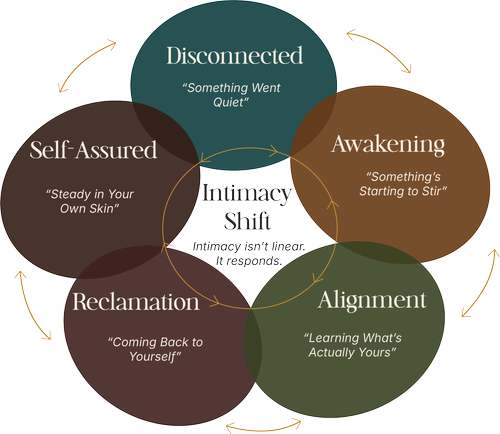
The arrows go both ways because the movement does too.
What each one tends to feel like.
This is the phase where you notice something is off, even if you can't name it yet.
Maybe sex has started to feel like a chore. Maybe you've stopped initiating anything — touch, conversation, plans — and hadn't noticed until just now.
Curiosity starts to return before clarity does.
Maybe you catch yourself wondering why something used to feel different. Maybe an offhand comment from a friend makes you question something you'd assumed was just how things are.
You start testing what's actually true for you, not just what you were taught.
Maybe you're finally naming a boundary you never had language for. Maybe you're realizing a script you inherited was never really yours to begin with.
Insight starts becoming practice.
Maybe you say what you want out loud for the first time. Maybe you choose rest, or pleasure, or distance — on purpose, not by accident.
Steadiness that isn't about never changing again.
Maybe change still comes, but it doesn't undo you the way it used to. Maybe you trust yourself to meet whatever's next — because you've done this before.
You can't change what you don't understand.
In about seven minutes, you'll receive your current stage, a personalized interpretation of what that stage means, and guidance for what comes next.
Created by Shamaree Brissett, MS, LPC · About seven minutes · No account required
Understanding doesn't stop at your result.
Every result is a starting point, not a label. Here's what you'll actually walk away with.
- Your personalized result
- An interpretation of what that phase means for you right now
- The challenges and opportunities specific to that phase
- Guidance for what comes next
- Resources tailored to your phase
A few things worth knowing.
Is there a "good" or "bad" phase to be in?
No. Every phase comes with its own challenges, opportunities, and invitations for growth. The goal isn't to reach a permanent destination — it's understanding what your intimacy is asking of you right now.
Can I move backward through the phases?
Yes. Intimacy Shift isn't a linear progression. Most people move through multiple phases more than once throughout their lives — relationships change, bodies change, circumstances change, and intimacy responds to all of it. That's why the framework is a living circle, not a ladder.
What if I don't fit neatly into one phase?
You probably won't. Many people recognize themselves in aspects of more than one phase. The assessment identifies the phase that appears most active right now, while acknowledging that intimacy is often layered and evolving.
Is this only about sex?
No. Sex can be part of intimacy, but intimacy is much broader — your relationship with your body, desire, pleasure, emotional connection, self-expression, vulnerability, and how you experience closeness with yourself and others.
How long does each phase last?
There's no universal timeline. Some phases may last weeks. Others may last years. The point isn't how quickly you move through a phase — it's what you learn from it while you're there.
What happens after I take the assessment?
You'll receive your current Intimacy Shift stage, an explanation of what it means, common challenges associated with that phase, and guidance for what may support you next.
How is this different from a personality quiz?
Intimacy Shift is not designed to tell you who you are.
It's designed to help you understand where you are.
Rather than assigning a fixed identity, the framework reflects a phase of growth and development. Your results can change as your life, relationships, experiences, and relationship with intimacy evolve.
This isn't an identity.
It's a phase.